


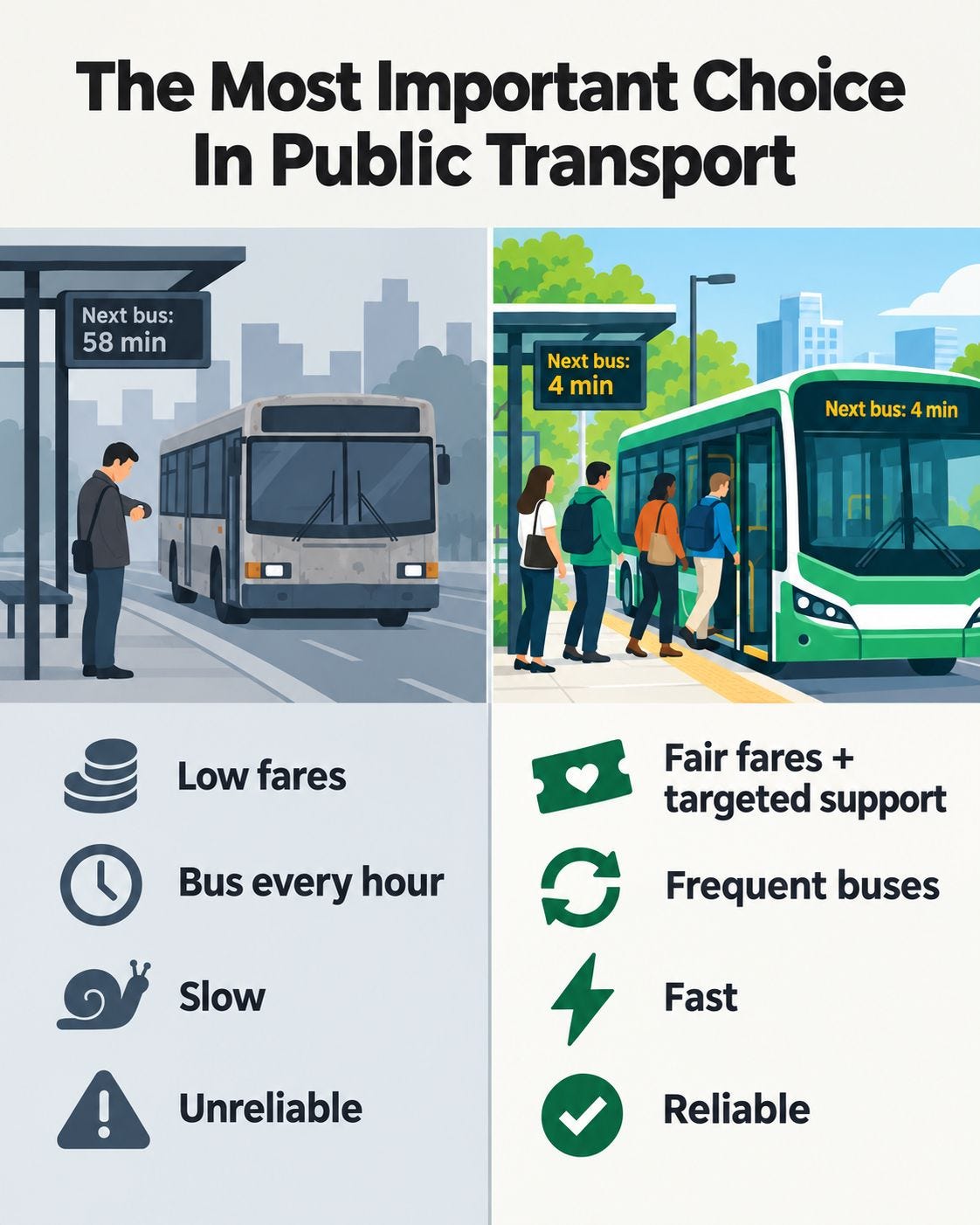
I spotted this article on LinkedIn, by a fellow named Russell King at the Policy Reform Toolkit in Australia. He’s given me permission to share it with you. His point could hardly be more relevant to what we’re seeing right here in Berkshire County, Massachusetts, where the Berkshire Regional Transit Authority has simply stopped running many of their “free” buses. (Is a bus really free if it isn’t even there?)
Most people think cheap or free fares are good for the poor, reduce congestion, and cut emissions. They are wrong on all counts.
At first glance, low fares look like a good policy. People on low incomes can travel more or save money. More people choose public transport, so fewer people drive, congestion falls, and emissions drop. Unfortunately, none of it is true.
To understand why, we need to look at what is really going on.
For many people on low incomes, the problem isn’t that they cannot afford public transport; it's that no public transport meets their needs. As a result, they are forced to spend thousands of dollars a year on a car. They need better public transport, not cheaper public transport. At least fewer people will drive, and emissions will fall. Wrong.
Cheaper fares do not get people out of their cars. Queensland, Australia implemented a 50c fare. Mode share out of cars barely budged. Free fares can create mode shift, but not out of cars. People in Melbourne stopped walking and cycling when their trams became free.
This is all bad enough, but it gets worse.
Cheap or free fares undermine the business cases for desperately needed public transport improvements. As a result, services are worse than they would otherwise be. To cover the costs, many transport agencies cut back on maintenance. In the short term, this doesn’t cause much of an issue, but over time, buses and trains become dirtier and less reliable, service deteriorates, and frustrated passengers switch to cars instead. The exact opposite of what we want.
I have heard some people claim that we can have cheap fares and great public transport services. However, this is rarely true and especially not now. Many government budgets have not recovered from COVID. Government priorities are rarely public transport. People prefer investments in healthcare, and many countries are increasing defence spending. Public transport is getting squeezed.
Low fares sound great and are popular with the public, but they are an unmitigated disaster for delivering better transport. We should charge reasonable fares, provide targeted support for those who need it and invest the money in better services.
Mr King also sent me the link to a blog post diving into this subject:
The debate about public transport funding often becomes stuck in a vicious, polarised discussion.
On one side, fiscal conservatives argue that public transport should operate like a business, covering its costs and ideally turning a profit. If it can’t make money, they say, perhaps the market is telling us something about whether people actually want these services.
On the other side, progressive advocates push for public transport to be treated as essential social infrastructure, like healthcare or education, with low or even free fares funded through general taxation. Public transport provides social benefits beyond economics, they argue, so it deserves the same treatment as other public services.
Both positions sound reasonable in isolation. Both have devoted followers who are absolutely convinced they’re right. And both are fundamentally wrong about how public transport actually works in the real world.
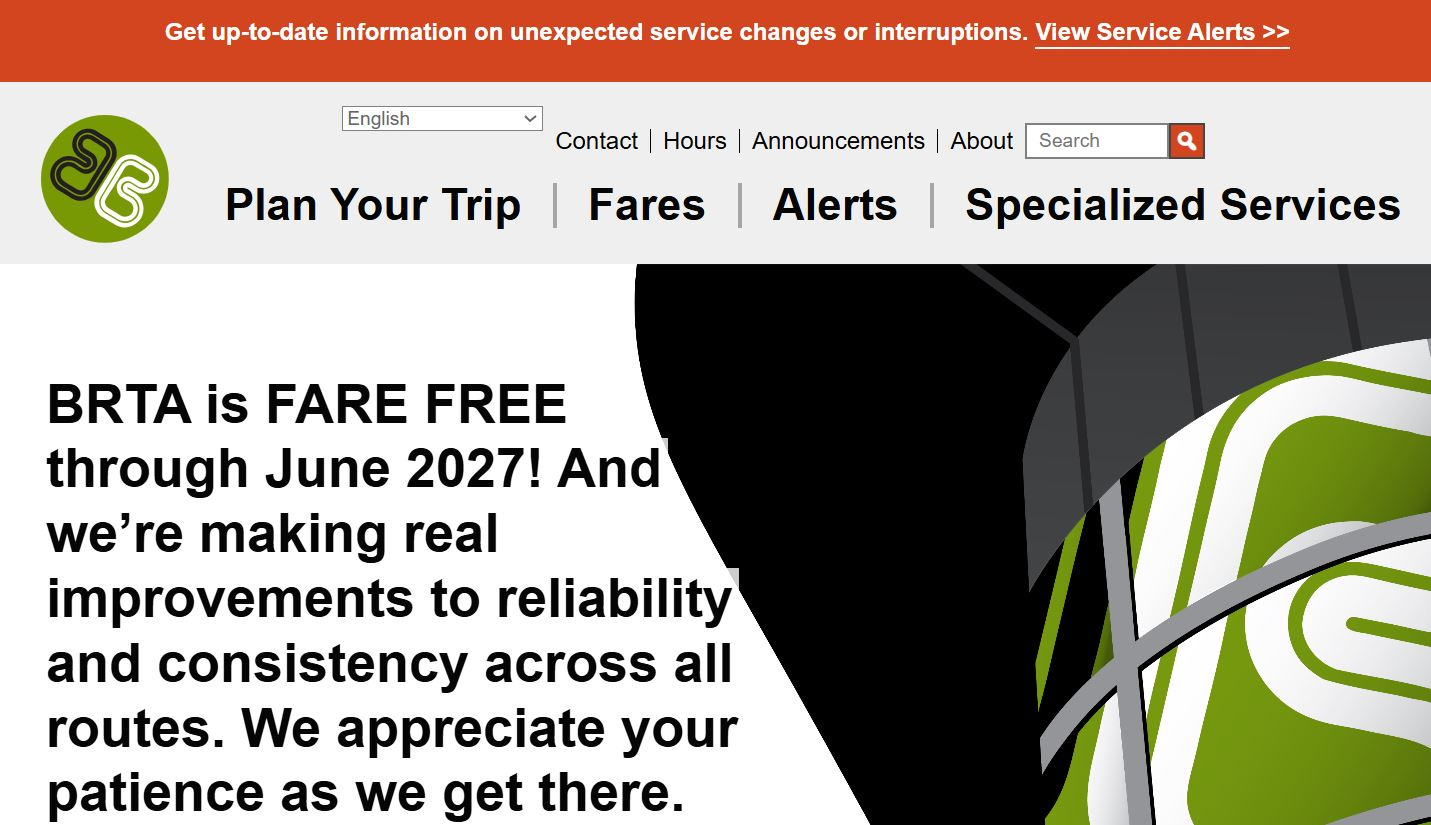
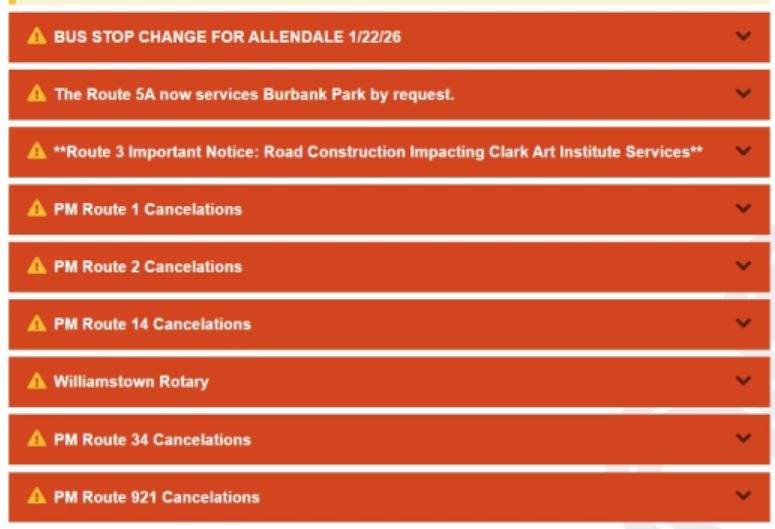
We want public transport to work, here and now, in our real world, don’t we? Read the whole thing. As an example, the BRTA website headlines FARE FREE, followed by a long long list of bus cancellations.
Connecticut!
Northwest Connecticut is on our minds, as it is the crucial link in restored passenger rail service to our tristate area. Here’s how the Connecticut DOT responded to an enquiry about adding a NWCT meeting to the schedule set out in our previous email (linked below):
Thank you for the inquiry about adding a public meeting for the state rail plan in Northwest Connecticut. We reached out to the Rail team, and they explained the locations selected were based on population centers, which host core railroad stations that are well-connected to passenger rail and bus networks. There have been similar requests to add meeting locations, however budgetary and timeline constraints are a challenge, so we won’t be able to accommodate an additional meeting in Northwest Connecticut at this time. However, the project team did stress if constituents cannot make one of the meetings, they are encouraged to participate via the online survey (with a mapping suggestion exercise) and to submit suggestions to the StateRailPlan@ct.gov mailbox.
Here’s a paraphrase: “The department will listen about the adequacy of rail connections in those towns that already have adequate rail connections, but not in those that don’t. And, sigh, the budget. It costs a a LOT of money to hold a 2-hour meeting in a public facility. At $500, that’s the cost of 1/16 of an inch of track, per Federal Transit Administration numbers. We must set priorities.”
Connecticut Railfans, Let’s Speak Up!

This message goes out to all the Nutmeggers who are passionate about rail transportation: this fall, you will have the opportunity to share your thoughts about the future of train travel in Connecticut for years to come!
Train Time podcasts
We’ve finally managed to reschedule the interview with Luke Bronin, former mayor of Hartford and the Democratic candidate in CT-01. Matt Silber and I want to hear about what he plans to focus on when he goes to Washington DC, and how he sees his past involvement with transport projects fitting into this new opportunity. Do you have questions for him? Send ‘em along!
Talking with Ian Hodkinson of Alstom, a global rail company

Alstom is a global rail company based in Canada, and I had the pleasure last week of a conversation with Ian Hodkinson, their Technical and Business Development Director of Transit Systems. As you’ll hear, we had a couple of technical issues during the recording, but we were resilient, and made it through—just as trains do.
Big Sky Rail has news for the rest of us

In this show, Dave Strohmaier and Karen Christensen pick up a conversation after nearly 5 years—years during which Big Sky Passenger Rail Authority (BSPRA) has really been making tracks. In 2023, the BSPRA was selected by the Federal Railroad Administration for further development and study, with a grant of $500,000 in seed money to help kick-start the …
All content in Train Time is shared under a Creative Commons License (CC BY-NC-ND):
Attribution (BY) – Always credit the author and Train Time as the original creator with a tag or link to https://traintime.substack.com.
Non-Commercial (NC) – Content cannot be used for commercial purposes.
No Derivatives (ND) – Content may not be modified, adapted, or repurposed.
Just added some examples from the BRTA website.